Ewoks, a sentient, short, and furry bipedal species, originated from Endor's forest moon. Their pivotal role in the Battle of Endor is what they are best known for. They aided the Rebel Alliance in overcoming the Galactic Empire's forces, leading to the destruction of the local shield generator and, subsequently, the second Death Star.
These inquisitive creatures, standing roughly one meter tall, were Ewoks. They were omnivores who employed spears, slings, bows, arrows, and knives as weaponry. They utilized hang gliders, battle wagons, and bordoks for movement. Despite their mastery of forest survival and rudimentary technological construction like catapults and gliders, the Ewoks had not advanced beyond stone-age technology when the Empire found them. Yet, they demonstrated rapid learning when presented with sophisticated technology incorporating straightforward mechanical ideas and operations.
Some Ewoks were forcibly taken from their home planet, becoming either pets or slaves. Others chose to leave out of curiosity, especially after the Battle of Endor resulted in the establishment of New Republic trading posts on their Forest Moon.
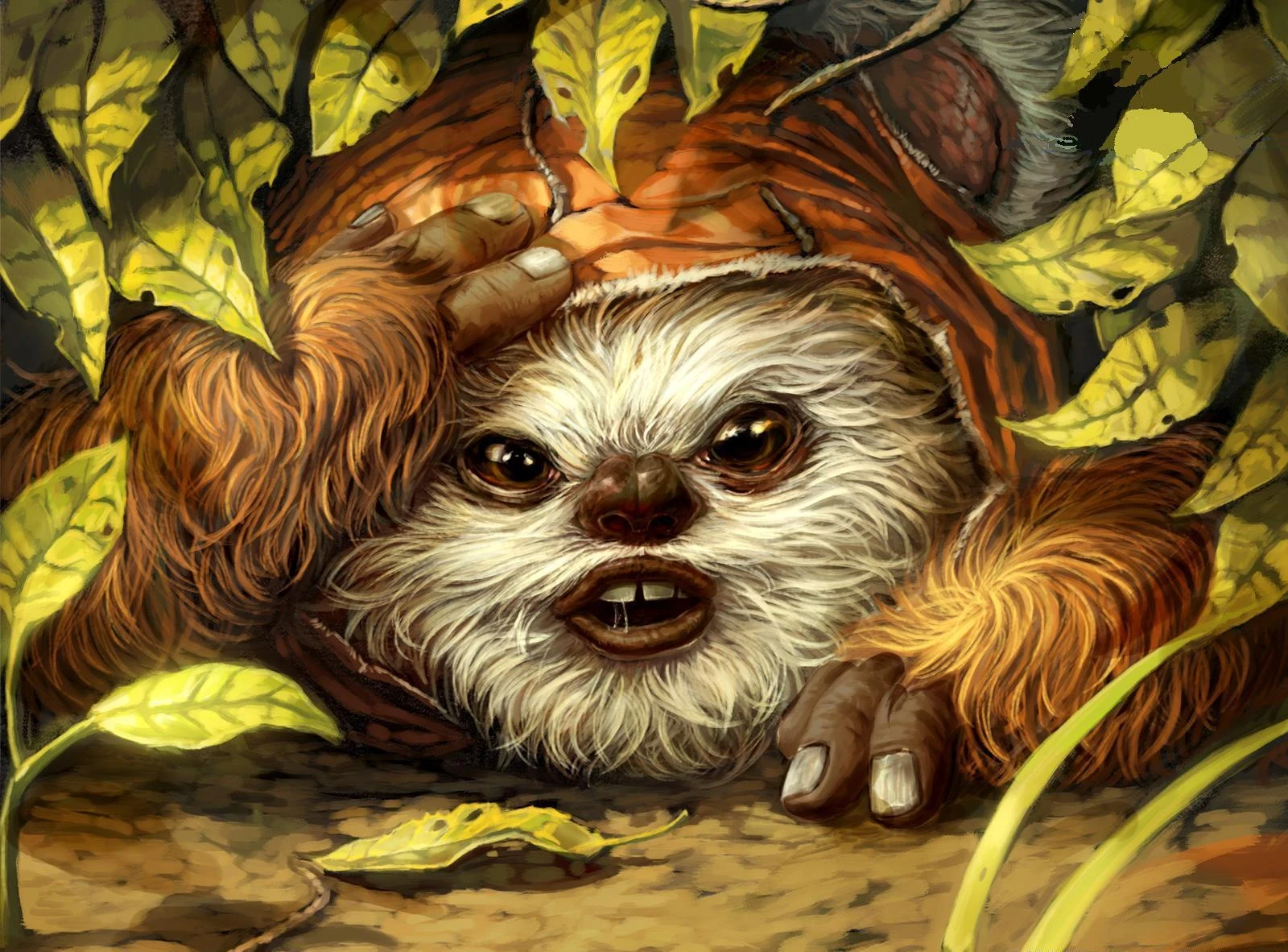
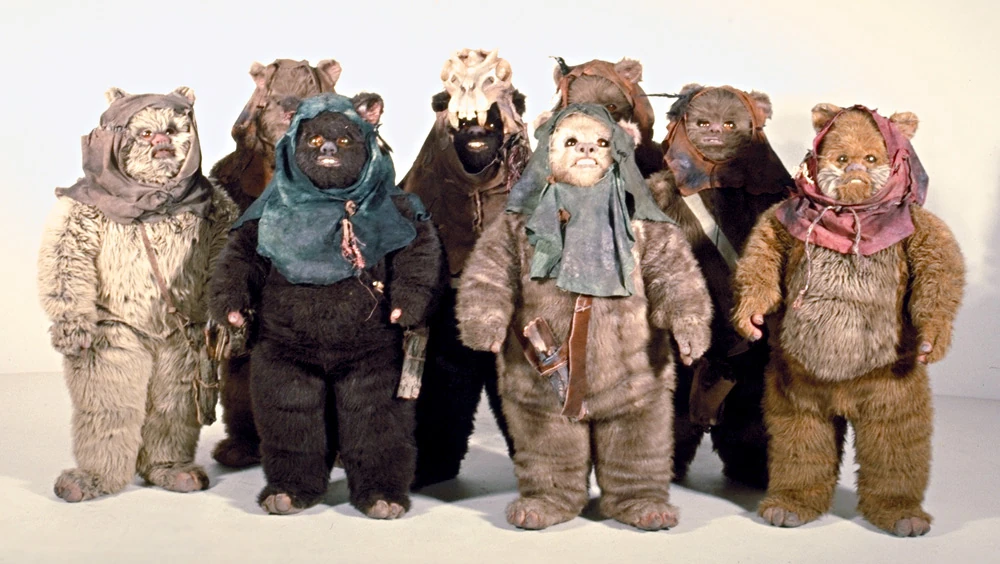
Ewoks were humanoid mammals possessing sentience, with an average height of about one meter, a size that could be advantageous for concealment. Their bodies were entirely covered in fur, with brown and black being the most prevalent colors. While some Ewoks had reddish or nearly white fur, red was considered the rarest color. While some had striped fur, most Ewoks had fur of a single color. They had large, expressive eyes, small humanoid noses, and hands featuring two fingers and an opposable thumb. In spite of their diminutive stature, Ewoks possessed enough physical strength to overpower Humans trained for combat. Mace Towani likened their appearance to "little bears," while they were sometimes called "mini Wookiees."
Ewok flesh also served as sustenance. During the Clone Wars, Ewok Jerky was available to patrons at the Power Sliders restaurant on Abafar.
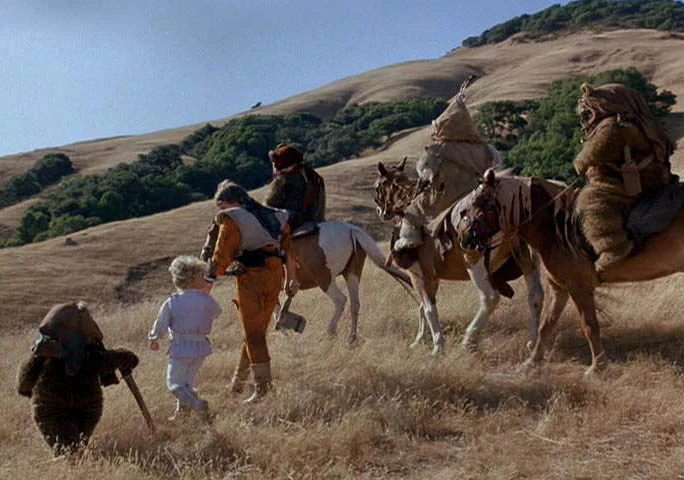
Even before the Galactic Empire's arrival on Endor, Ewoks, despite their rudimentary technology and remote world, were not completely unknown in the broader galaxy. A mercenary Ewok named Treek became involved in the events of the Galactic War as early as 3639 BBY. Centuries later, during the Clone Wars, "Ewok Jerky" was a menu item at Power Sliders, a restaurant located on the planet Abafar. Prior to the Battle of Yavin, Mon Mothma used the expression "a Rodian in Ewok's clothing" in a speech she gave on Agamar.
The Ewoks of Bright Tree Village, under the leadership of Chief Chirpa and the medicine man Logray, had considerable interaction with people from other planets. These Ewoks were instrumental in helping the shipwrecked Humans Mace and Cindel Towani save their parents from a Gorax. Later, a group of Sanyassan Marauders, who had crash-landed on the Forest Moon decades earlier, attacked the Ewoks, killing all of the Towani family except Cindel, and capturing some Ewoks. Wicket Wystri Warrick, a young Ewok, joined forces with Cindel and another shipwrecked Human (Noa Briqualon) to defeat the Sanyassans, free the prisoners, and locate the parts needed to repair Briqualon's ship. They ultimately assisted in stopping an Imperial scientist named Dr. Raygar, who sought to seize the sacred Sunstar and use it to gain control of the Empire.
The Ewoks also interacted with the various other sentient species inhabiting the Forest Moon, including the Yuzzums, Gupins, Lizard Warriors, and Teeks. Their swamp-dwelling relatives, the Duloks, were rivals of the Ewoks, and often caused them problems.
Even the inhabitants of the distant Tatooine, like Roan Novachez, who created a comic series titled Ewok Pilot about an Ewok pilot, were aware of the Ewoks. Despite being recognized as a sentient species, they were not represented in the Galactic Senate as of approximately 195 BBY.
The Galactic Empire, upon commencing operations on Endor's moon, initially dismissed the native Ewoks as an insignificant species. However, an initial contact attempt with Ewoks by Imperial soldiers went awry, leading to Ewoks harassing Imperial outposts. Numerous Ewoks ended up as slaves. Imperial activities were concentrated around the area near Bright Tree Village. Princess Leia Organa, a member of a Rebel strike force, encountered and befriended Wicket W. Warrick, who welcomed her into his village as a respected guest.
Meanwhile, another group of Ewoks captured Luke Skywalker, Chewbacca, Han Solo, R2-D2, and C-3PO. The Ewoks identified the protocol droid C-3PO as "The Golden One," a deity from their prophecies. Despite Wicket's and Leia's objections, Logray intended to sacrifice them as a feast in C-3PO's honor. However, Skywalker's use of the Force, along with C-3PO's warnings, soon changed Chief Chirpa's mind.
That evening, C-3PO recounted the Rebel heroes' exploits to the Council of Elders. The Ewoks welcomed the Rebels into their tribe and joined their cause. The Ewoks participated in the ground battle to destroy the Imperial shield generator on the forest floor, using their primitive weaponry to defeat the stormtroopers and scout walkers of the Empire, though they suffered significant casualties from Imperial blaster fire. This assistance was crucial to the destruction of the second Death Star and the Rebel victory at the Battle of Endor. Later that night, the Ewoks held a massive celebration that echoed throughout the forest. The Ewoks were dedicated to protecting their forest by any means necessary.
Following the Battle of Endor, some Imperial propaganda falsely claimed that the Ewoks had become extinct due to the battle's aftermath. In reality, the Rebel forces successfully prevented the Death Star II's debris from severely impacting the forest moon's environment.
Hume Tarl, an Imperial Stormtrooper who survived the battle, harbored resentment towards the Ewoks for their brutal combat tactics, which resulted in the deaths of many of his comrades. He later shared his experiences with Cindel Towani, expressing his negative views on the Ewoks.
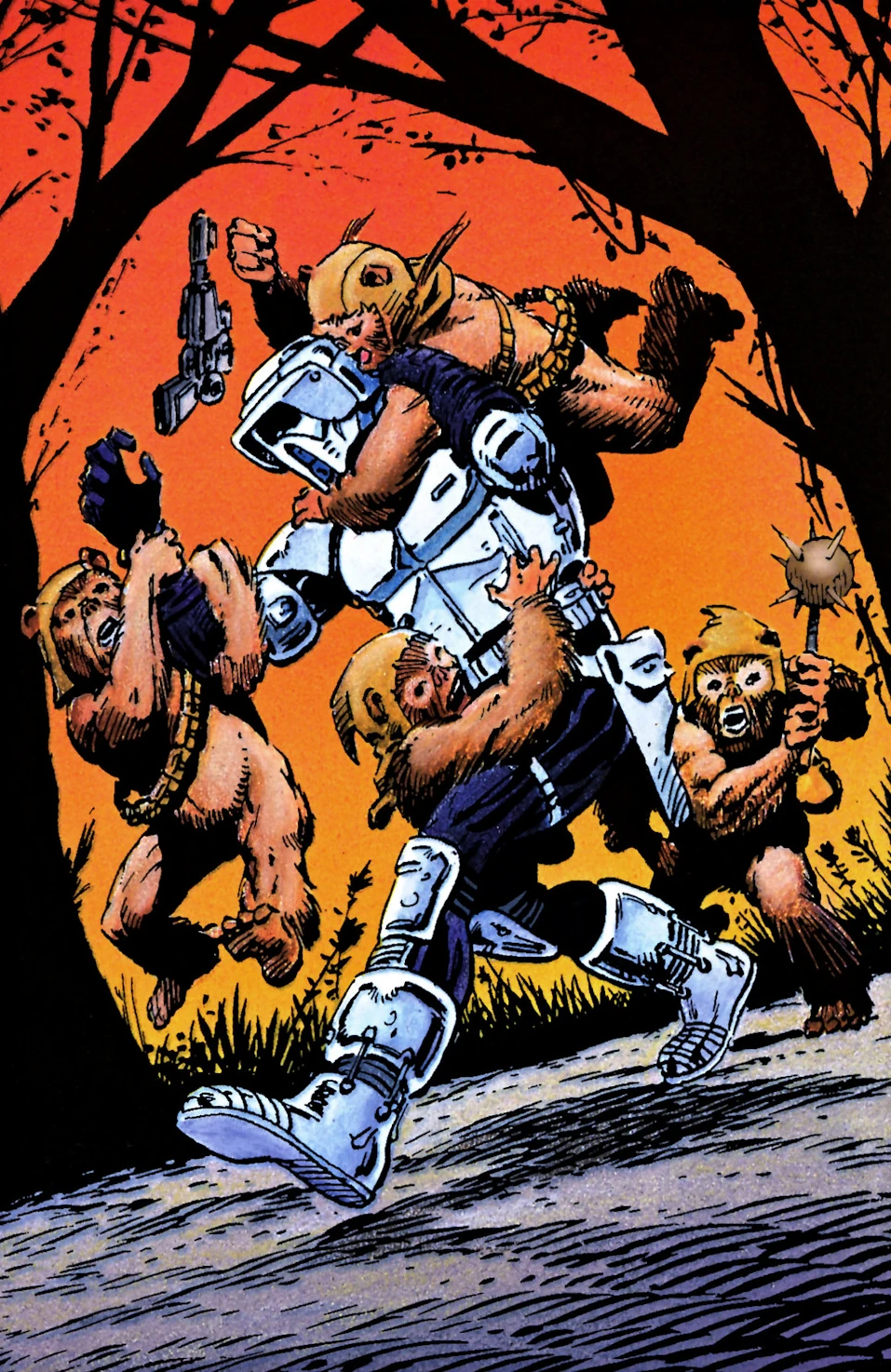
After the Rebellion transitioned into the Alliance of Free Planets, Bright Tree Village served as the Alliance's temporary headquarters. Even with the Imperial forces gone from Endor, the Ewoks faced a period of unrest. The Hiromi provoked a conflict between the Lahsbee and the Ewoks, which the Alliance resolved. Shortly after, a second battle took place in the skies above Endor when the Alliance was attacked by Nagai and Maccabree forces led by Lumiya, who proclaimed herself the Dark Lady of the Sith.
Although the Alliance forces soon left Endor after repelling Lumiya's forces, the Ewoks had become part of the Galactic community. In the following years, several Ewoks ventured off Endor. The New Republic established trading posts on the Forest Moon. Most Ewoks who left their homeworld were adventurous types, such as the smuggler Tarfang, or the Ewok soldiers who joined the New Republic forces at the Second Battle of Coruscant in 10 ABY. By 9 ABY, a substantial Ewok colony also existed on the planet Svivren, although the details of their initial settlement remain unknown.
On Endor itself, the New Republic later established semi-permanent outposts (such as Salfur's Trading Post) near Ewok villages. Through these seasonally staffed outposts, the Ewoks of Endor maintained sporadic contact with the wider galaxy as non-participating members of the New Republic.
During Darth Caedus' reign, Luke Skywalker and the Jedi forces utilized the Ewok's home as a temporary base before relocating to the transitory mists. When questioned about Wicket, Luke stated that his group was on the opposite side of the moon. The Jedi were able to use old Imperial landing pads that were still operational.
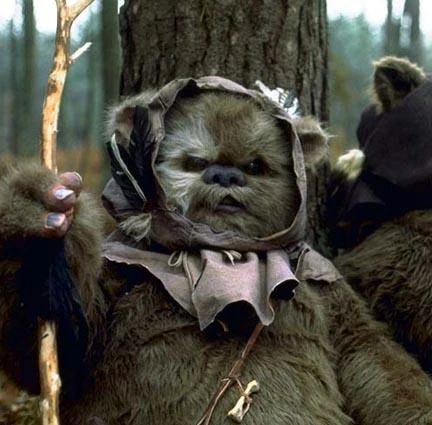
Ewok tribal organization featured a Council of Elders, led by a chief, governing each village. A medicine man, responsible for mystical knowledge and healing the injured, also resided in the Ewok village. Warriors from different tribes wore tattered head coverings to distinguish their tribe. They also wore wooden chest shields, the jawbones of small animals, and sharp teeth. Some adorned themselves with decorations such as feathers, necklaces, and pendants, creating a cluttered appearance.
Prominent Ewok tribe members carried totems indicating their status. The leading warrior wore a headdress of feathers known as the "white wings of hope." The eldest son of the tribal leader wore a headdress called the "red wings of courage," while the second son wore the "blue wings of strength."
Unmarried male Ewoks typically lived alone in the forest, building small huts near the tree city to assist the Ewoks in their work. Unmarried females would leave gifts of food, clothing, or weapons on the doorsteps of these males to show their attraction and express how much the village missed them, hoping they would return as part of a family and as the female's mate.
If a male Ewok decided to take a mate, he needed to construct a family hut in the tree city for himself and his mate. The construction of a new hut signaled his decision to take a mate, prompting all unmarried females to try to win him over. He would not make his choice until his home was finished. The chosen female had the option to reject the male or the hut he had built.
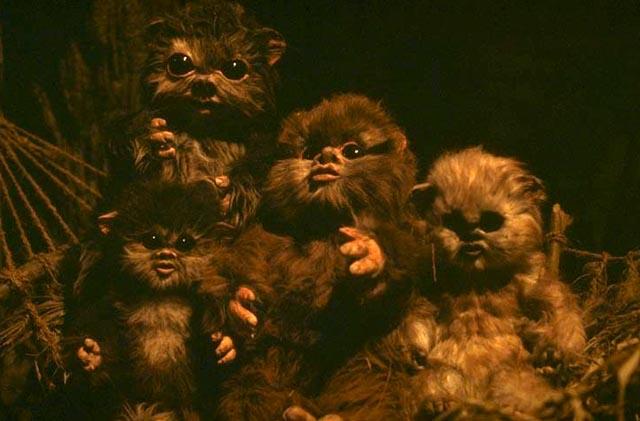
Ewoks displayed a strong bond with their fuzzy offspring, known as woklings. Newborn babies were adored by the entire Ewok village. Children received ample attention, and their care was considered a shared responsibility. Woklings had limited rights and were expected to learn many rituals and legends that would guide their moral conduct throughout their lives. Upon reaching adulthood, Ewoks participated in the Festival of Hoods, which marked their transition from wokling to Ewok.
Most Ewoks inhabited tree villages high in the forest moon's trees, constructed among the closely spaced trees. A typical tree village featured a "Central Village" of thatched-roof huts on the primary limbs, positioned high enough to be safe from ground predators. Suspended bridges spanned the gaps between trees, connecting distant huts, while knotted rope ladders provided access up and down.
In most tree cities, the village Elders directed the construction of the largest huts directly on the tree trunk. These central buildings belonged to the tribe's chief. The chief used the largest open areas for village gatherings, meetings, council fires, and storytelling ceremonies.
Family groups maintained their own dwellings in clusters on the outlying trees. Separate huts were built for unmarried females, elders, and visitors. A sealed building, taller than the rest of the tree city, served as the community's food storage.
Some Ewoks chose to live a nomadic life rather than in villages. More traditional Ewoks began calling them Jindas, after the nomadic tribe of Jindas that lived on Endor.
Bright Tree Village, home to the tribe led by Chief Chirpa, exemplified a typical Ewok tree village.
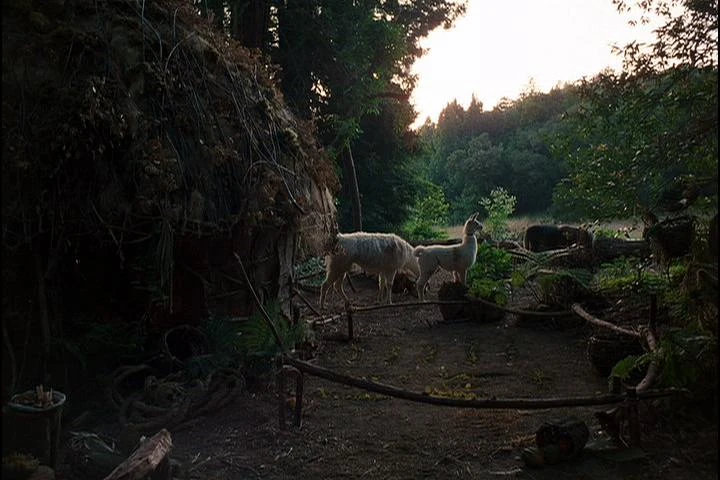
Some Ewoks from the Bright Tree Village tribe once resided in isolated huts on the forest floor. However, they eventually moved back into the trees because the ground villages were vulnerable to attacks by the brutal Sanyassan Marauders.
Ewoks also built homes on calm, shallow lakes. These lake Ewoks constructed their villages on stilts in the water, which provided protection from large predators. They primarily obtained food by setting wicker traps to catch fish. The older Ewoks spent their time harvesting marsh grasses and drying them in the sun, then using these dry grasses to make mats, clothing, baskets, and decorative tapestries. The young Ewoks enjoyed splashing in the water and digging in the mud for buried shellfish.
These Ewoks also constructed wooden sailboats and oars.
Some Ewok tribes built their homes on a rock face beside a spraying waterfall. Ewok engineers created an elaborate system of waterwheels, powered by the waterfall's force. These waterwheels drove large wooden gears that rotated grindstones, operated conveyor belts across the village, and powered wooden elevator platforms that moved up and down the cliff.
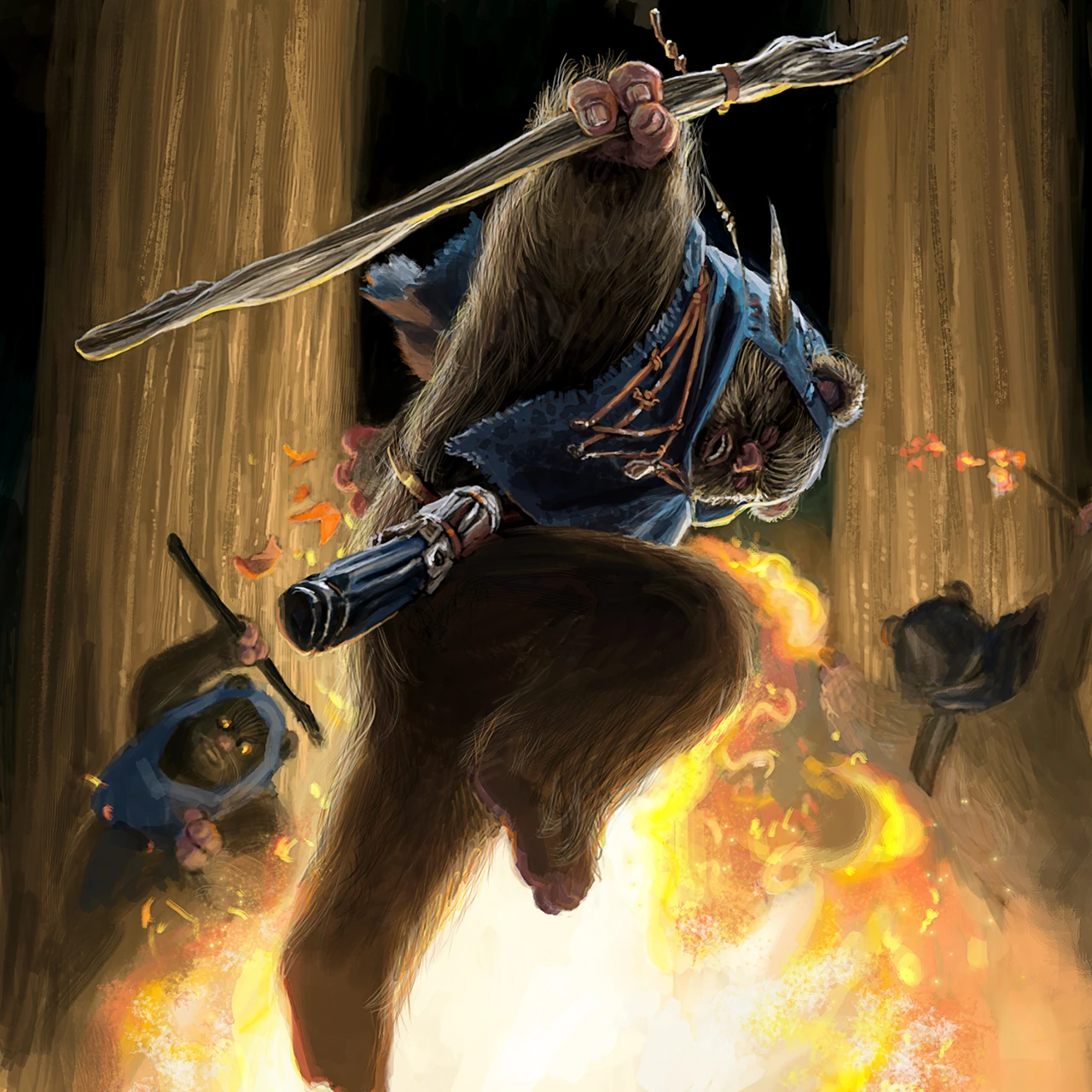
The Ewoks found joy in singing and playing music during celebrations, festivals, and rituals. They also believed that music enhanced their work. Resourceful by nature, Ewoks tended to use anything they could find, incorporating a variety of drums, horns, flutes, and other simple instruments into their music. During the Ewok and Rebel celebration following the destruction of the second Death Star, one Ewok used a collection of Imperial stormtrooper and naval trooper helmets as drums, creating a range of tones. Ewok music also featured rudimentary harmony.
The Ewok language was known as Ewokese. It was related to several other languages spoken on Endor, including the Yuzzum language, which had been recorded from Yuzzum colonies off-world and programmed into certain protocol droid models. These linguistic connections allowed Ewoks to communicate relatively easily with many other beings on Endor. Ewok physiology also enabled them to learn and speak most other languages, including Galactic Basic Standard.
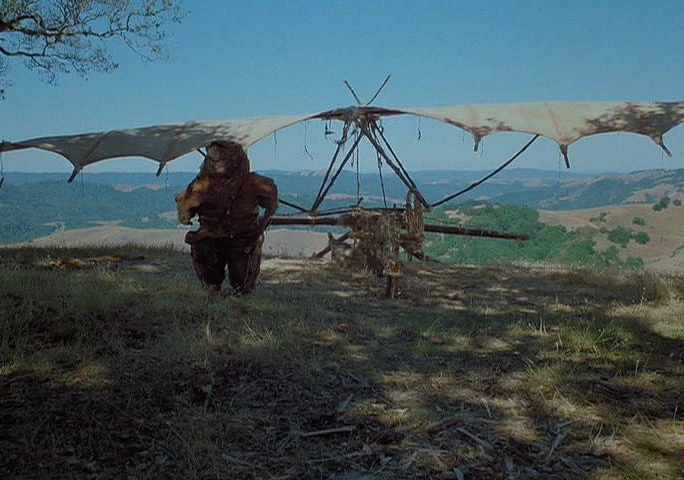
Ewoks would descend to the forest floor to hunt, employing stone-tipped arrows and spears, as well as intricate traps, to capture their prey. They prided themselves on being skilled hunters.
While a single hunter could trap small animals, an entire Ewok hunting party could capture animals as large as a boar-wolf. The Ewoks had developed efficient methods for hunting these formidable creatures, using spears and poison darts. They would first set a trap with bloody meat scraps from a previous hunt and then place a vine net on the forest floor. When the wolf approached the meat, it would become entangled in the net. Ewok warriors would then emerge from the underbrush and attack the trapped wolf. One boar-wolf could provide enough meat to feed an Ewok village for several days.
Smaller game was killed using small sling nets. When a creature stepped into a loop, it triggered a pressure trap, causing a pinned sapling to break free and fling the animal into the nearest tree.
Tek swee was a trap whose name translated into Basic as "head hitter." This trap was a common defense against the Gorax. When a Gorax attempted to raid an Ewok village, the Ewok warriors would release a massive log roped onto trees, which would swing into the Gorax like a giant battering ram. Many of the traps designed for Goraxes were successfully used against the Empire during the Battle of Endor.
Another food source for the Ewoks were mattberries, which they squeezed for juice. These juices were mixed with water and fermented into a bitter brew.
The "Tribal Games" were a series of competitions that drew Ewoks from various scattered tribes. These events included dancing and storytelling, but also more dangerous activities. Tree-jumping was a popular game among young Ewoks, involving climbing the highest lifetree and leaping from the highest limb, catching themselves on lower limbs until they reached the ground. A missed grip could result in serious injury.
Ewoks were sometimes known to smoke combustible substances in pipes for recreational or spiritual purposes.
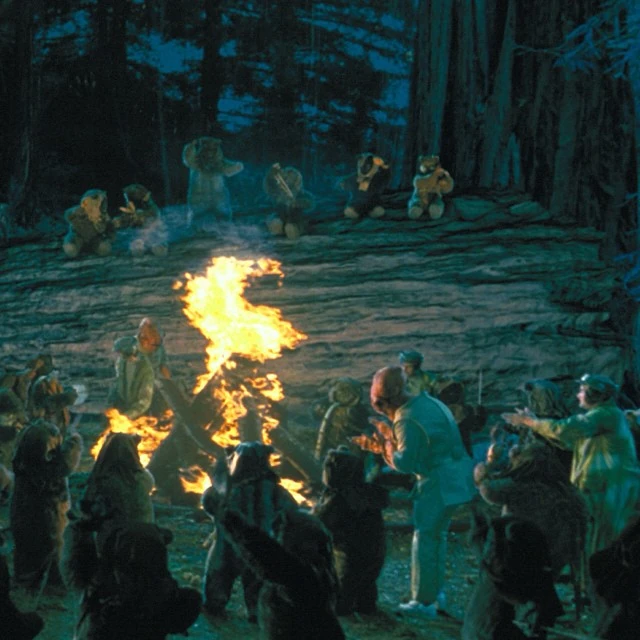
Throughout the year, Ewoks celebrated elaborate festivals honoring rain, sun, springtime flowers, fruits, and love. These festivals brought together tribe and family groups to feast, sing, dance, and enjoy themselves. They also practiced certain "Dark Rituals" involving bloody sacrifices, held at night under the light of smoky bonfires. Ewok shamans would toss hallucinogenic herbs into the fire, inducing vivid dreams. Ewoks generally regarded Hallowe'en, during which they dressed up as ghosts, as the best celebration of the year.
The Ewoks used a variety of weapons, including knives, stone spears, slingshots, and bows and arrows. During the Battle of Endor, they threw large rocks at stormtroopers, used ropes to dismount scout troopers from their 74-Z speeder bikes (often breaking their necks), and used logs to trip and crush AT-STs.
Their arrows were tipped with a potent neurotoxin that caused an extremely gruesome death. Even minor wounds would result in the victim clawing off any headgear (if wearing any) and gasping for air, as the neurotoxin paralyzed every muscle in the victim's body, including their lungs, as evidenced by Hume Tarl's recollections of the Ewoks' fighting style during the Battle of Endor.
They also employed pit traps, luring enemies into them by feigning retreat, causing them to be impaled by stakes fixed to the ground.
They would often restrain their enemies, remove any helmet, and bludgeon them with stone axes and knives made of volcanic glass.
Additionally, Hume Tarl implied that the Ewoks would steal blasters from fallen stormtroopers and use them against the Imperials. They also demonstrated familiarity with walker movements, as evidenced by two Ewoks piloting Tempest Scout 2 alongside Chewbacca shortly after hijacking it.
The towering trees surrounding them played a significant cultural role for the forest-dwelling Ewoks. These hunter-gatherers were deeply spiritual, believing themselves to be descendants of the Great Tree, a sacred tree within the forests. Their religion centered on nature worship, with numerous religious ceremonies designed to appease various gods associated with weather, trees, the hunt, engineering skills, and fertility. Darker spirits represented the dangers of the forest. The Ewoks held grand festivals celebrating rain, sun, spring flowers, and fruits. They also practiced "Dark Rituals" involving bloody sacrifices, conducted at night under the light of burning bonfires. The shamans would toss hallucinogenic herbs into the fire, inducing vivid dreams among the Ewoks.
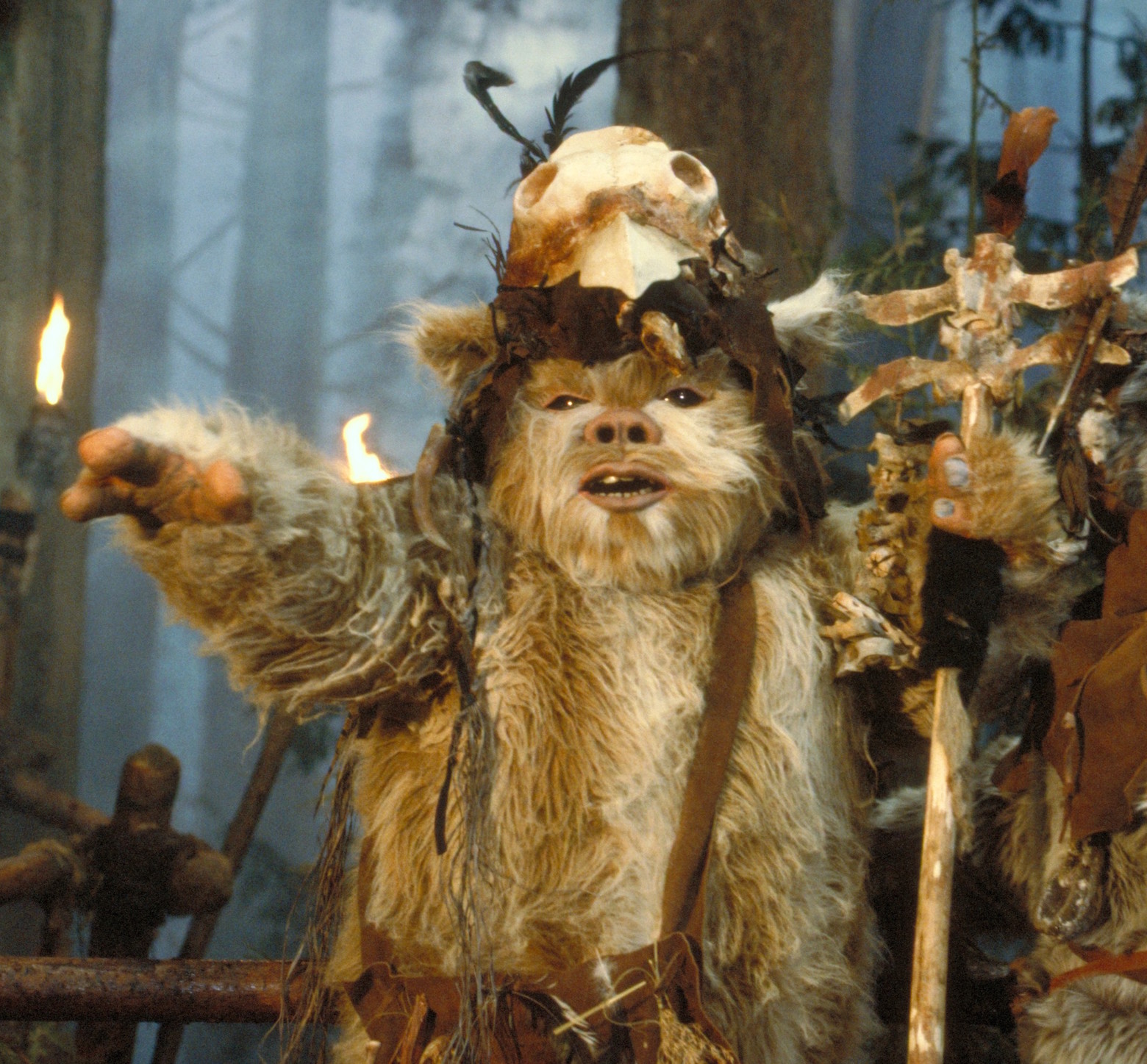
Every village had its appointed mystic, otherwise known as a shaman. Occasionally, the shaman was just a charlatan, inventing explanations of the gods' desires and the methods to appease them. However, some possessed authentic abilities, at times demonstrating powers akin to Force-sensitives. In exchange for the shaman's services, the village provided them with whatever they desired, such as crystals, shells, polished skulls, and other intriguing treasures. It was common for shamans to wear large animal skulls atop their heads.
Shamans functioned as the tribe's healers, often utilizing herbal remedies with unpleasant odors. A variety of fungi, lichens, roots, berries, flowers, epiphytes, and bark were employed, each with different medicinal properties.
The Ewoks referred to the gigantic coniferous trees that dominated the forest moon as "Soul Trees" or "Life Trees," holding them in deep religious regard. Upon the birth of each wokling, the village planted a seedling. The Ewok maintained a connection to their totem tree throughout their life. Upon death, it was believed that their spirit would inhabit their personal totem tree.
During times of crisis, the village shamans would endeavor to communicate with the ancient spirits residing within the oldest trees for guidance and counsel. The shamans maintained that this was a private ritual. The Ewoks never questioned the sacred advice delivered by the shamans, despite never having heard these ancient voices themselves.
The Ewoks revered a vast collection of gods and spirits, including these:
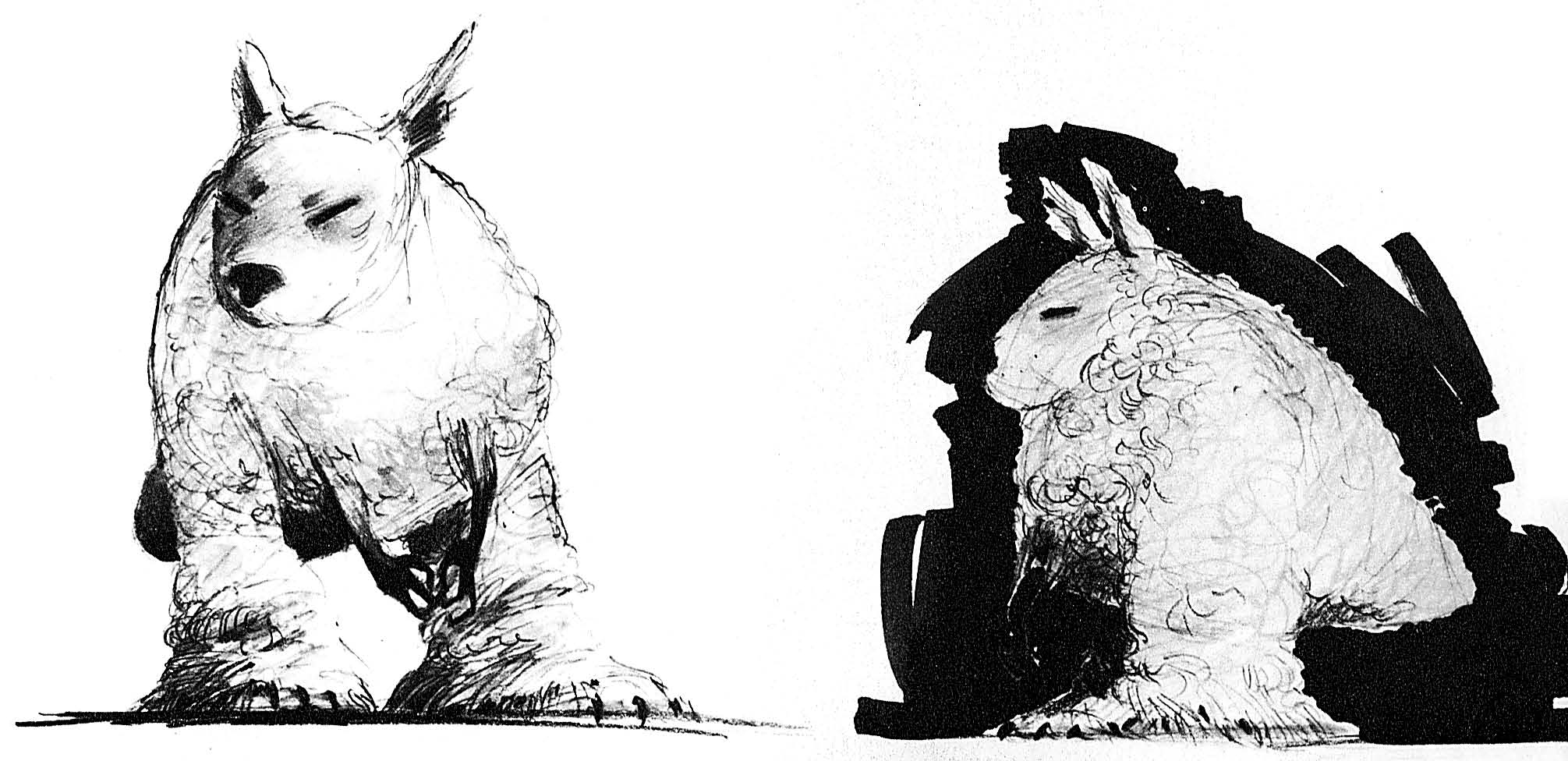
George Lucas envisioned a primitive society overthrowing the Empire in what he intended to be the saga's final installment. Initially, he considered using Wookiees, but this idea was abandoned after establishing Chewbacca's technological aptitude. As a result, he conceived the Ewoks, a new species whose name is "Wookiee" spelled backward (with modifications to resemble a Native American tribe). The Ewoks are never explicitly named in the dialogue of Return of the Jedi; the name only appeared in the script directions, the novelization, the film's credits, and various spin-off and promotional materials. In the director's commentary for the 2004 re-release of Return of the Jedi, as well as the documentary Empire of Dreams: The Story of the Star Wars Trilogy, Lucas also identified the Viet Cong as the main inspiration for the Ewoks, particularly their triumph over the Galactic Empire.
On the Dark Horse message boards in 2005, Randy Stradley asserted that Ewoks, along with Vulptereens, are among the species incapable of manipulating the Force, thus precluding them from becoming Jedi. However, Geonosis and the Outer Rim Worlds, published a year prior, featured an Ewok Jedi.
The Ewok tribe from Return of the Jedi later featured in two television specials, Caravan of Courage: An Ewok Adventure (1984) and Ewoks: The Battle for Endor (1985), as well as the animated series Ewoks (1985 – 1987). Lucasfilm regarded these works as canon before the 2014 rebranding. Cindel Towani, a character from the TV movies, made an appearance in the subsequent novel Tyrant's Test.
The "Ewok" was among the initial twenty-four character templates utilized by the Star Wars: The Roleplaying Game, initially published in the first edition rulebook.
Certain Legends sources have attempted to resolve ambiguity concerning Endor's fate following the destruction of the second Death Star, stating that the majority of debris either vaporized or was intercepted by the Rebels. In "Apocalypse Endor," a story featured in Star Wars Tales issue #14, an Imperial veteran of the Battle of Endor alleges that the Ewoks on Endor died off due to the Death Star's debris, but a cantina patron refutes this, claiming the Rebels prevented any environmental catastrophe.