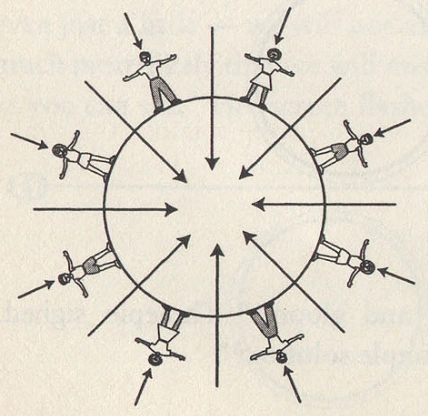
 The force that drew smaller objects towards the center of a planet was its gravity.
Gravity, sometimes called gravitation, defined the attractive force between two objects. Its strength depended on their mass and separation distance. In practical terms, gravity ensured beings remained grounded and caused dropped items to fall. Celestial bodies, such as planets, moons, and stars, all generated a gravitational field. A larger body possessed a stronger gravitational pull, attracting objects more forcefully towards its core. On a planet's surface, this direction was typically called "down." However, realspace contained minimal natural gravity, leading to the reliance on artificial gravity generators aboard starships for simulated gravity. Achieving orbit around a planet required a precise equilibrium between gravitational attraction and the spacecraft's velocity.
The force that drew smaller objects towards the center of a planet was its gravity.
Gravity, sometimes called gravitation, defined the attractive force between two objects. Its strength depended on their mass and separation distance. In practical terms, gravity ensured beings remained grounded and caused dropped items to fall. Celestial bodies, such as planets, moons, and stars, all generated a gravitational field. A larger body possessed a stronger gravitational pull, attracting objects more forcefully towards its core. On a planet's surface, this direction was typically called "down." However, realspace contained minimal natural gravity, leading to the reliance on artificial gravity generators aboard starships for simulated gravity. Achieving orbit around a planet required a precise equilibrium between gravitational attraction and the spacecraft's velocity.


Within advanced galactic societies, certain technologies existed to counteract gravity's effects. A common illustration involved low-maintenance antigravity devices known as repulsorlifts. These enabled the hovering of landspeeders and assisted starships during takeoff and landing procedures. Additional gravity-manipulating tools included tractor beam projectors and acceleration compensators.
The majority of inhabited planets and moons throughout the galaxy experienced a gravitational acceleration close to the standard 9.81 m/s². For species originating from planets with standard gravity, encountering worlds with significantly different gravitational forces could be a disorienting experience. On a planet with weaker gravity, a Human could jump with ease to great heights. Conversely, on a planet with stronger gravity, the same Human might feel heavily weighed down. As an example, the planet Carida featured a gravitational pull nearly double the galactic standard. This was deliberately exploited by the Military Academy located there, where the enhanced gravity intensified the rigor of field exercises. Some individuals believed that low-gravity environments, such as Columus, offered health advantages to obese individuals by alleviating stress on the heart and promoting greater mobility. However, this was inaccurate. In reality, reduced muscle activity in low-gravity conditions tended to decrease metabolic rate.
Gravity played a crucial role in Obi-Wan Kenobi's discovery of the lost planet Kamino. All nearby objects were pulled towards the location where Kamino should have been, despite the absence of any records for that location in the Jedi Archives.